
How to Do Effective Video Prospecting
By Ryane Tully · March 13, 2024

Video prospecting is a sales outreach tactic where reps send short, relevant videos to potential buyers to explain why they are reaching out and what should happen next. It works best when the video is specific to the prospect, paired with a clear written CTA, and tracked for views, replies, and meetings.
Helpful Summary
- Use video prospecting when a text-only email cannot show enough context, proof, or personality.
- Keep the first video short, specific, and tied to one prospect problem.
- Use a simple script: context, reason, value, next step.
- Track views, watch time, replies, meetings, and follow-up actions.
- Pitchlane is a fit when you want to record your pitch once, personalize for every lead and push the results into tools such as Instantly, Smartlead, lemlist, HubSpot, or Apollo.
What is video prospecting?
Video prospecting is the use of video messages in outbound sales. A rep may record a webcam intro, a screen walkthrough, a short audit, or a personalized landing-page video, then send it by email, LinkedIn, or a sales sequence. The goal is not production quality; the goal is relevance.
Does video prospecting work?
Video prospecting can work when it makes the outreach more specific than a text-only message: for example, a quick account observation, a relevant screen walkthrough, or a follow-up tied to prior engagement. It is unlikely to help when the same generic video is sent to every account without a clear next step.
How to do video prospecting in 7 steps
| Step | What to do | Output |
|---|---|---|
| 1 | Research the account and buyer | One relevant trigger or pain point |
| 2 | Choose the video format | Webcam intro, screen walkthrough, audit, or follow-up |
| 3 | Write a short script | Context, reason, value, CTA |
| 4 | Record or generate the video | A clear message with no long setup |
| 5 | Personalize the landing page or thumbnail | Company, context, or offer relevance |
| 6 | Send through the right channel | Email, LinkedIn, or sequence tool |
| 7 | Follow up from engagement | View-based and reply-based next steps |
Video prospecting script template
Use this as a 30- to 45-second starting point:
Hi {{first_name}}, I noticed {{specific_company_trigger}} and thought this might be relevant because {{pain_or_goal}}.
I recorded this to show {{one_specific_observation_or_idea}}.
The short version: {{your_offer}} helps teams {{outcome}} without {{common_problem}}.
If this is worth exploring, would you be open to {{clear_next_step}}?
A good script sounds like one person speaking to one account. Remove any line that could be sent unchanged to every prospect.
When should you use video instead of text-only outreach?
Use video when visual context changes the quality of the message:
- You can show a prospect’s website, product, ad, job post, or workflow.
- The account is high-value enough to justify extra personalization.
- A previous email was opened or clicked but did not receive a reply.
- Your product is easier to understand when shown on screen.
- You need to make an account-based campaign feel less automated.
Use text-only outreach when the message is simple, the account fit is low, or the video would only repeat the email.
Can recruiters use video for candidate outreach?
Yes, when the video is a short, optional recruiter-to-candidate message rather than a recruitment film or video interview. Recruitment video outreach is most appropriate when a recruiter has a specific, job-related reason to contact someone and keeps the role facts, next step, and communication options in writing as well as video.
This section provides operational examples, not legal advice. Employment, privacy, accessibility, electronic-communications, recordkeeping, and accommodation duties vary by country, state, role, and channel. The recruiting organization must identify the rules that apply to its campaign and have its legal, privacy, HR, and accessibility owners approve the process.
Recruitment video outreach vs recruitment marketing vs video interviews
These formats involve different recipients, purposes, and safeguards. On a narrow screen, scroll the table horizontally.
| Format | Who communicates with whom? | What the video does | What it is not |
|---|---|---|---|
| Recruitment video outreach | Recruiter to a potential or active candidate | Introduces a relevant role, adds context, or explains a next step | A screening or assessment |
| Recruitment marketing | Employer to a broad candidate audience | Presents a team, workplace, role family, or employer brand | One-to-one candidate outreach |
| Video interview | Candidate to an employer or interview panel | Records or supports a candidate response | A prospecting message |
“Recruiting video” can also mean an athlete highlight reel or a student-enrollment video. Here, it means a recruiter-to-candidate message. Staffing agencies may also use video to contact hiring clients, but that is commercial prospecting and should be managed separately from candidate communication.
Where can video fit in the recruiting process?
The recruiting stage should determine whether a video helps and what must stay in text. On a narrow screen, scroll the table horizontally.
| Recruiting stage | Useful role for video | Keep in writing | Main caution |
|---|---|---|---|
| Passive sourcing | Explain the role and one job-relevant reason for contacting the person | Role facts, sender identity, next step, and a way to decline | Do not include sensitive inferences or unrelated personal details |
| Follow-up after interest | Add one useful update or introduce the hiring manager or process | The promised material, action, and deadline | Do not rely on the candidate having played the video |
| Interview reminder | Add optional human context or preparation guidance | Date, time zone, format, participants, rescheduling, and accommodation route | Video must not replace accessible logistics |
| Re-engagement | Explain what has materially changed since prior contact | The new role details and communication options | Respect preferences and suppression records in the system that owns them |
| Staffing-agency client development | Share a hiring-market observation or sourcing approach with a prospective client | The commercial offer and next step | Treat it as sales outreach, not candidate outreach |
As an operational default, keep sensitive decisions in the organization’s approved human process and durable written record. A prospecting video is a poor channel for a rejection, medical or accommodation information, compensation negotiation, or another decision that materially affects the candidate. Whether a particular written record or accommodation is legally required depends on the applicable jurisdiction and process.
What should a recruiter say in a candidate outreach video?
Use four parts: context, specific relevance, role value, and a low-pressure next step. Base the relevance on appropriate, reviewed information rather than assumptions about the person’s identity or circumstances.
For passive sourcing, a message could follow this structure:
Hi [first name], I’m [recruiter name] from [company]. I’m contacting you about the [role] position because [job-related reason]. I recorded a short introduction to the team and the work. The essential details are also in this message. If it may be relevant, would you prefer the full description or a brief conversation?
For re-engagement, lead with the material change rather than pretending this is a first contact:
Hi [first name], we spoke previously about [role or team]. I’m reaching out again because [scope, location, seniority, or timing] has changed. I included the updated details in writing. If the new version is relevant, you can reply here; if not, let me know how you would prefer us to handle future contact.
A staffing agency contacting a hiring client needs a different script:
Hi [name], I noticed [approved account or hiring trigger]. We are seeing [specific role-market observation] for teams hiring [role type]. I recorded one idea for [hiring problem]. Would a short discussion about [defined next step] be useful?
Do not manufacture familiarity or imply that a reusable video was recorded uniquely for each recipient. If a person needs the video in another format, make the same useful information available without requiring playback.
Candidate outreach video checklist
The applicable law comes first. The following are conservative operational defaults for a team to take through its own legal, privacy, HR, and accessibility review:
- Establish and document the purpose, lawful basis or other required authority, notices, channel rules, retention period, and candidate-rights process for the jurisdictions involved.
- Minimize campaign fields to what the defined purpose needs. Avoid protected-characteristic references, medical or family information, and personal details unrelated to the job.
- Segment by a legitimate message need, not assumptions about identity, background, circumstances, or “culture fit.”
- Keep suppression, prior-contact, preference, retention, and candidate-history records in the system that owns them.
- Require a human to review the base message, variables, landing page, and representative test output before launch.
- Provide accurate captions or a transcript, and repeat essential role facts, dates, actions, and contact routes in accessible text.
- Make it easy to decline, request another format, or state a communication preference.
- Treat clicks and video views as communication signals, not evidence of candidate quality, motivation, seriousness, or fit.
Primary guidance reviewed 19 September 2026: the UK Information Commissioner’s Office’s draft recruitment and selection guidance covers employers, agencies, head-hunters, and consultancies, warns that candidate information may be sensitive, and explicitly separates legislative “must” requirements from “should” and “could” good practice. Its data-minimisation guidance says UK GDPR data should be adequate, relevant, and limited to what is necessary; the ICO notes that the recruitment draft and related guidance are under review. In the United States, the EEOC’s Prohibited Employment Policies/Practices page, reviewed 19 September 2026, says recruitment may not discriminate on protected grounds and advises limiting pre-employment inquiries to information essential to job qualification. For media accessibility, W3C WAI’s Captions/Subtitles resource, reviewed 19 September 2026, explains that captions convey the speech and non-speech audio needed to understand video. These sources cover specific jurisdictions or technical guidance; they are not a universal compliance checklist.
Pitchlane’s privacy policy explains Pitchlane’s own practices. It does not establish whether a recruiting campaign complies with an employer’s obligations or a candidate’s communication preferences.
How can Pitchlane fit a recruiter outreach workflow?
A recruiting team could adapt Pitchlane’s record your pitch once, personalize for every lead model for a carefully segmented campaign. After one reusable recording, the documented setup proceeds through Import Leads, Customize Landing Page, and Review Test Video before the results are handed into a connected outreach workflow.
The approved recipient list, permission model, suppression rules, candidate history, sending, and hiring-stage records should remain in the systems and processes the team already uses. Pitchlane is not presented here as an ATS, sourcing database, interview platform, or hiring-decision system.
Pitchlane pushes into supported outreach and CRM workflows, including HubSpot, Salesforce, Close, and Apollo. These are workflow handoffs, not claims of native ATS support. Teams comparing the personalized-video layer can also review the video prospecting tools guide or explore Pitchlane.
What did a documented Pitchlane workflow test show?
Pitchlane’s 29 August 2026 editorial workflow test used a real 83-row outbound import: 82 rows were accepted and one was rejected for a data error. The result is documented in the Pitchlane vs Loom workflow, including the reusable-script step and the import-result capture. It demonstrates two practical controls relevant to a recruiting adaptation: write one recording for a coherent segment, then inspect rejected rows and representative test output before processing a batch.
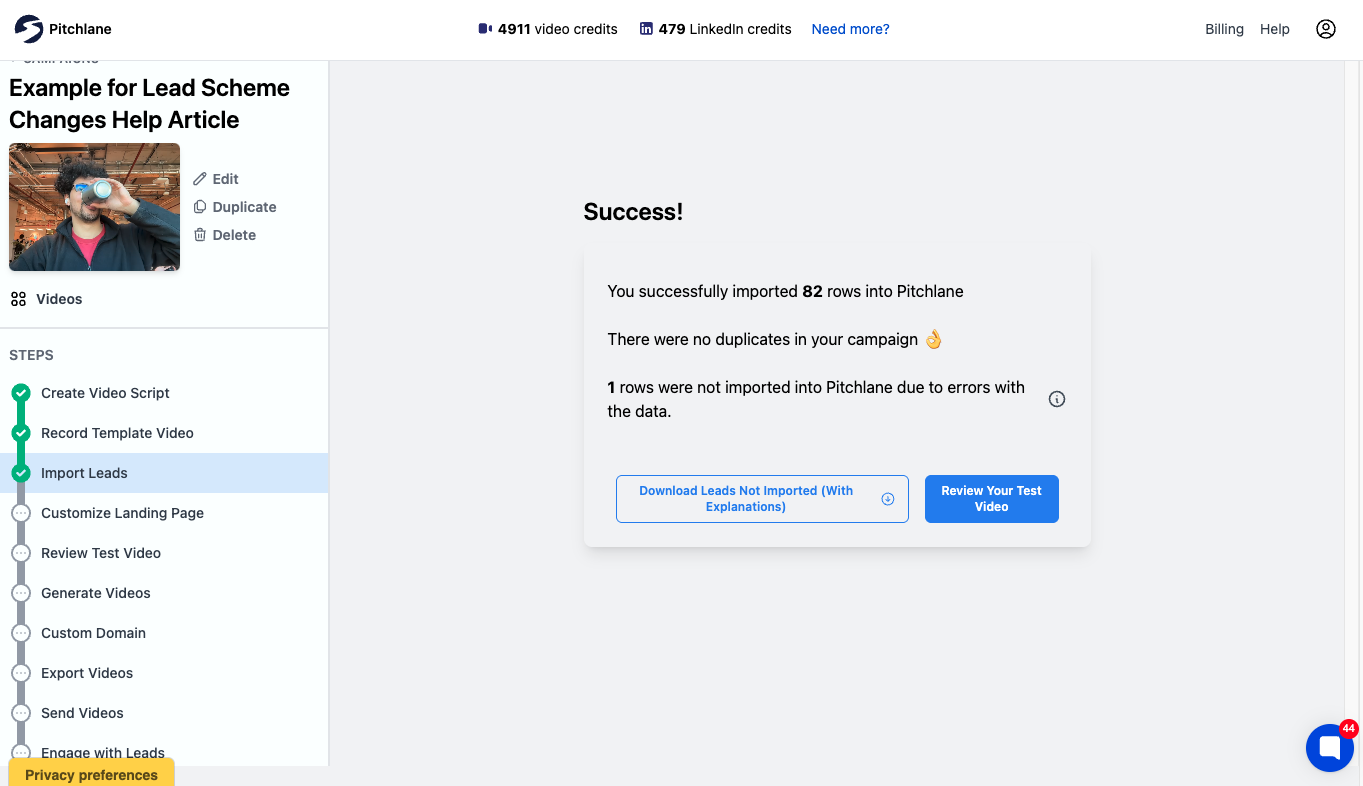
For a recruiter-specific dry run, use fictional records first and map only the fields the message actually needs. On a narrow screen, scroll the table horizontally.
| Example field | Use in the workflow | Do not put here |
|---|---|---|
| First name | Written greeting or landing-page context | Guessed identity information |
| Role title | State the specific opening | Inferred seniority or suitability |
| Job-related reason | Explain why this role may be relevant | Health, family, age, ethnicity, or other sensitive inference |
| Role URL | Give the candidate a durable source for details | A tracking URL that hides the destination |
| Reply or preference route | Let the recipient respond, decline, or request another format | A forced video-only next step |
Limitations: the pictured import was a general outbound test, not a recruiter campaign; it used no candidate data, sent no recruitment messages, and measured no candidate outcomes. The fictional field map is an editorial test of the proposed workflow, not evidence that a recruiting team has adopted it or that it complies in any jurisdiction. A recruiting organization still needs its own representative-data test, approvals, accessibility check, and sending-system controls.
10 steps to effective video prospecting
Step 1: Research your target audience
Start with the person and account. Look for the trigger that explains why you are reaching out now: hiring, funding, a new market, a broken workflow, a relevant page, or a public initiative. Save one useful detail for the opening line.
Step 2: Choose the video idea
Pick the format that matches the reason for outreach. Webcam intros build familiarity. Screen recordings are better for audits, product walkthroughs, and account-specific observations. A follow-up video can reference a previous view, reply, or clicked asset.
Step 3: Craft a concise script
Write in four parts: context, reason, value, next step. Do not open with a long bio. The prospect should understand within a few seconds why the video exists.
Step 4: Record or generate the video
Keep the production simple: clear audio, readable screen, direct point. If you need to send video at scale, use a workflow such as Pitchlane’s record your pitch once, personalize for every lead approach rather than recording every asset from scratch.
Step 5: Personalize the supporting assets
The surrounding email, thumbnail, landing page, title, and CTA matter as much as the video. Personalization can reference the company, use case, or reason for outreach without claiming the video says the prospect’s name.
Step 6: Choose the channel
Send the video where the prospect is most likely to respond. Email works well for structured sequences. LinkedIn can work when the relationship context matters. Sales engagement tools help when several touches must be coordinated.
Step 7: Track engagement
Track the metrics that influence follow-up: delivered, opened or clicked where available, video viewed, watch time, CTA clicks, replies, meetings booked, and opportunity creation.
Step 8: Follow up based on behavior
A full view with no reply deserves a different follow-up than no view at all. Reference the original reason for outreach, not just the fact that a video was watched.
Step 9: Test one variable at a time
Change the hook, audience, CTA, or format separately. If every variable changes, you will not know why performance moved.
Step 10: Keep the workflow connected
A video prospecting process should connect to your CRM, mailbox, and outreach tools. Pitchlane pushes into Instantly, Smartlead, lemlist, HubSpot, Apollo, and related workflows, so reps can keep using the systems that already own the campaign.
Video prospecting metrics to track
- Delivery: Was the message accepted by the inbox or platform?
- Email engagement: Opens and clicks where your stack provides them.
- Video engagement: Views, unique viewers, watch time, and completion.
- Conversation metrics: Replies, positive replies, objections, and referrals.
- Pipeline metrics: Meetings booked, opportunities created, and deal stage movement.
- Operational metrics: Time to create, time to send, and follow-up completion.
Common video prospecting mistakes
- Recording a generic video and calling it personalized.
- Spending too long introducing yourself before naming the prospect’s problem.
- Sending a video with no written context.
- Using a vague CTA such as “let me know what you think.”
- Ignoring view data when planning follow-up.
- Making claims in the video that sales or marketing cannot substantiate.
Video prospecting tools and stack
Most teams need three layers: data, outreach, and personalization. Data tools help identify accounts and contacts. Outreach tools run sequences and follow-up. Video tools add the personal asset that can make a message feel less generic.
For a tool-by-tool breakdown, read the video prospecting tools guide. If you are comparing the broader prospecting stack, see our business prospecting tools guide and sales outreach tools guide.
Frequently asked questions
How long should a prospecting video be?
Keep the first video short enough to make one point clearly. For most outbound messages, aim for a concise intro, one relevant observation, and one next step rather than a full product demo.
What should I say in a sales prospecting video?
Say why you are contacting this person, what you noticed, how it connects to a problem or goal, and what next step you recommend. Avoid a generic company pitch.
What tools do I need for video prospecting?
You need a way to identify prospects, send messages, create videos, host or share those videos, and track engagement. Pitchlane covers the personalized video layer and pushes into common outreach and CRM workflows.
How do I personalize video at scale?
Use a repeatable script and a workflow that separates the reusable pitch from the personalized fields. Pitchlane is built around a simple model: record your pitch once, personalize for every lead.
Take the next step
If the blocker is list quality, fix the list first. If the blocker is generic messaging, add video prospecting to the campaign and measure whether replies and meetings improve for the accounts that matter.